|
Whale Sightings and Boat Maintenance
Mid November is time for boat maintenance. Sea Hawk is out of the water for our annual Coast Guard Inspection, and routine maintenance. We hauled out this morning in 35mph winds in Bellingham. The weather has cleared, which makes boat yard life a little nicer. We're planning on being back in the water early next week following our inspection, and will be prepared for tours during the last two weeks of November. Whale sightings have continued into the fall. Humpbacks and Transient Killer Whales have been spotted periodically off San Juan Island, and Victoria. We're excited for Thanksgiving weekend tours, and hoping for good weather. For those who check out blog regularly, we'll do out best to keep you updated on tours and wildlife sightings. We're still operating kayak tours daily. Captain Brian from the Boatyard
Whales Sighted October 26th 2008
Captain's Log October 26th We were lucky (Kendall my naturalist and myself) to have some fall travelers interested in whale watching on a beautiful, sunny, clear and cool fall day yesterday. We were even more fortunate that my friend Ivan called to let me know he had spotted our Resident K-Pod off the west side of San Juan Island, headed north towards our home port at Roche Harbor. By the time we had left the harbor, the whales had traveled all the way up to Open Bay, only 2 miles from our dock. We headed out of the Harbor in north bound direction, with the intention of meeting up with the whales on the West side of Henry Island. The plan worked, and we had our first view of the whales 1 mile north of Kellett Bluff on Henry, just as the whales turned and started heading south again. We had some great views of the whales as we traveled with them against the flood tide in a southerly direction. Around Open Bay, a group of Dalls Porpoise altered their course and seemingly started teasing the lead group of whales which they occasionally do. Wonderful day out on the water, and we look forward to more great fall/winter trips with whales.
Autumn is upon us!
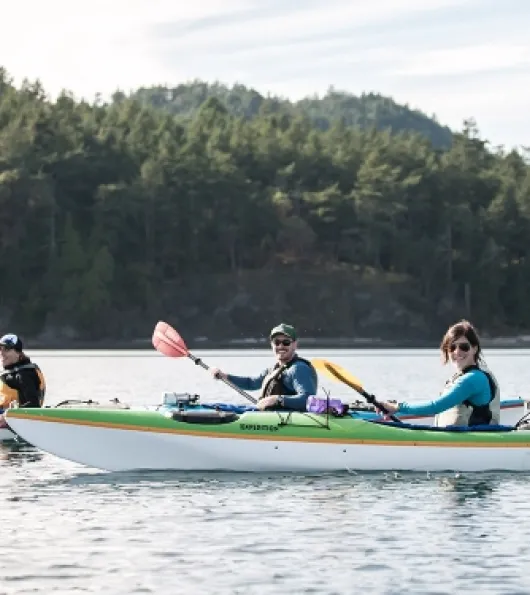
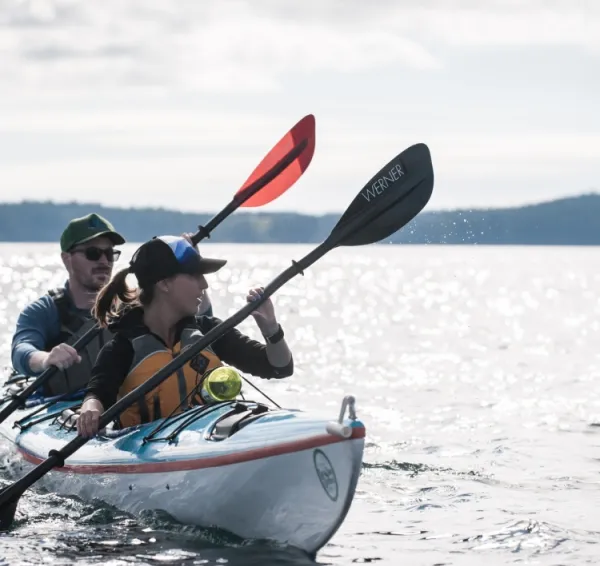
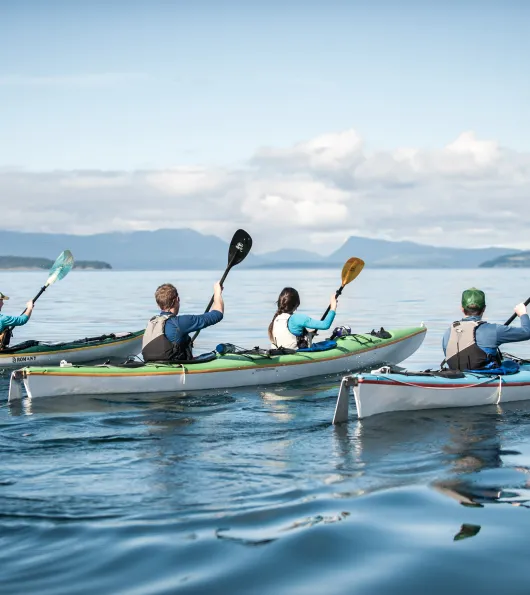
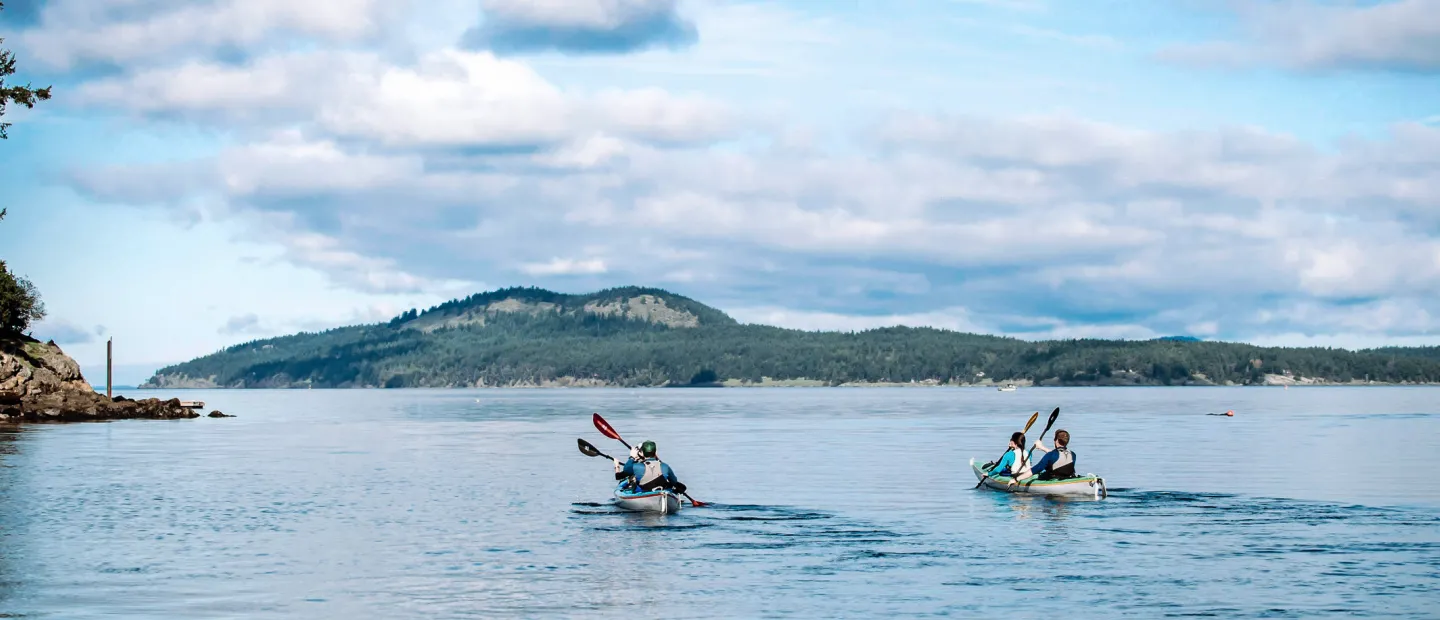
Well, the leaves are changing, the air is growing cooler and the sun is setting earlier-- that must mean that fall is here! It's been a great summer of paddling here, and we're not done yet. Although our regular season ends this weekend, San Juan Outfitters will continue to be available by reservation for both kayaking and whale watch trips through Thanksgiving and maybe later. We will be offering 3-hour, 5-hour and multi-day sea kayak trips along with wildlife/whale watch tours via motor vessel. In addition, we also are available for family tours, birding tours and special occasion charters. The summer crowds have waned and it's a great time to get out on the water for inividual attention from your guide or naturalist and enjoy the quiet splendor of the San Juans. Come join us!
And the fishing is good...!
Last week I set off on a multi-day trip with some expert fishermen in tow. Although I grew up in Portland, Maine I don't know much about seafood and was happy to soak in what they shared. As we paddled, Cindy and Carl let out some line and occasionally felt some tugs. The most successful spots were right off some beds of bull kelp, and they caught all kinds of rockfish there. Early on the morning of day two (before the others were up), Carl and I paddled out to the northern tip of Jones and he tried his luck there. The fish that came up were really neat-- big googly eyes, sharp spines along their back and one with sharp teeth! I'm still waiting for the official reports and great pictures of what was caught, but it made for quite an interesting trip. Although I can't say I'm a converted fisherman now, it was truly something to get a look at all these never-before-seen creatures silently inhabiting the water in which I paddle almost daily!
Steller Sea Lions spotted!
A few times within the past weeks I've spotted a Steller sea lion out on the west side of Henry Island! (At least, I've only ever seen one at a time, so I'm assuming it's a lone creature, but there could be more...) They are easily identified because of their huge size, light flecked coloration and distinct movement. Compared to harbor seals they have a much more elongated face, long whiskers and those external ears are a dead giveaway. Adult male Steller sea lions can weigh about 2 tons-- that's almost four times as much as the females! These opportunistic carnivores enter the Salish Sea to feed on small sharks, squid, rockfish, salmon, cod, and herring, although they have to be wary as their size makes them a tasty meal for the transient killer whale. Out on the water they are beautiful to watch, albeit from a distance. Their sheer strength and power is clearly visible when they surface and they can swim incredibly fast. Steller sea lions can be found all over the west coast although most live in Alaska, where their numbers have declined about 80%! One important thing to remember about these sea lions is that they are listed as endangered under the Federal Endangered Species List, and there is intensive research underway to try to understand what is making the population plummet. I've been lucky to see them a few times, and it's always a treat.
A very successful Inn to Inn Trip!
I recently set off on another multi-day trip, but this one wasn't like the last. It was our first Inn to Inn trip, which meant we kayaked by day, but slept in warm and luxurious beds at night! Darren, Marrin and I set off and spent the day paddling, hiking and generally exploring the area (and also came up with lots of wild ideas as to what was behind a door carved into stone) and then headed over to Orcas Island for the night. From our boats it was a short walk up to the Deer Harbor Inn (their first guests to arrive by kayak!) where instead of camping and cooking dinner, we checked in and had wine, warm soup and bread, steak and lamb for dinner! A night's sleep on what has got to be the world's most comfortable beds followed. The next day, after being fortified with a tasty breakfast, we set off and paddled leisurely across San Juan Channel towards Roche Harbor. That evening we sat outside, watched the Colors Ceremony as the sun set and enjoyed a few of the Madrona's signature drinks before calling it a night. The next day we paddled out on the west side, and although we were hoping to see whales, we did get a great look at a bald eagle, harbor seals and a Steller sea lion! This Inn to Inn trip consisted of a few days of kayaking some beautiful stretches of water, picnic lunches on quiet beaches, eating and drinking at fancy restaurants and a wonderful night's sleep at the day's end. A fine idea and a great trip.
Hungry? Try some bull kelp!
Paddling west off San Juan Island there are many places where the current picks up speed and covers the shallow rocky coast with fast moving water. Where those conditions occur is a prime place for bull kelp to take hold and develop. Bull kelp is an incredible organism known for its amazing growth-- 6 to 12 inches a day! Each stipe is attached to the ocean floor by a holdfast, and then grows up towards the surface. As they develop they twist and tangle together creating a complex underwater forest that becomes home and haven for many critters.
Sea urchins slowly move about the rocky bottom chewing away at the holdfasts while crabs can climb up towards the top looking for their meals. Schools of fish dart through, not seeing the great blue heron that perches silently above. Harbor seals find sections of fast moving water and ride the surface currents on their backs and can haul out on top of the floating tubes to rest in the sun. Even whales will check out the kelp beds! Gray whales can enter a forest to escape from predators (transient killer whales) or look for invertebrates, while some killer whales have been seen spinning through the kelp beds. Why? Researchers aren't sure exactly, but guess those whales must like the sensation-- kind of like a car wash for whales!
Bull kelp is an incredibly important organism for the ecosystem in the Puget Sound but did you know humans use this kelp too? All over the west coast of North America bull kelp is harvested for use-- pharmaceuticals use it for chemical extraction, commercial companies turn it into a food additive, the dried stipe can be woven into baskets, and some crazy people eat it raw! Yep, the fronds are pretty tasty and paddling out here in the San Juans there are ample places to grab a bite. Talk about local organic food!  Here's a photo I snapped of two wonderful paddlers trying their first taste of bull kelp---mmmm!
September is my favorite month in the San Juan Islands. The pace slow down a bit and the weather can be quite beautiful, which has been true for this past week. We had several kayaking trips go out yesterday and today with near perfect conditions; sunny skies and calm seas. This week, guides have seen a ton of wildlife on the kayaks ranging from seals, to baby racoons to killer whales. On our 5-hour tour on Monday saw all 3 pods of orcas, which is called a superpod and is fairly rare to see. A few times a summer, all three pods join together to socialize and mate and this may last a few hours or a few days. But when this happens, there can be close to 90 whales in a relatively small area. Our whale watching trips have been successful as well. We've been seeing whales consistently (about 90% of the time) although today was a trip in the 10% bracket which did not see whales. But I must say that they still had a wonderful wildlife trip. They saw harbor seals, bald eagles, 2,000 pound Stelllar Sea Lions, harbor porpoise and Dall's porpoise. A porpoise is quite similar to a dolphin, it is a cetacean which m akes it closely related to dolphins and whales but is smaller in size. Harbor porpoise tend to be shy while Dall's Porpoise are more friendly and may ride the bow waves on a boat, so if you are on the bow of the boat, you can look down and see them quite closely. This experience happened today and the guests had a great time.
WHALES!..... just around the corner
It is yet another gorgious day here in Roche Harbor! Moderate temperatures, blue skies, and a super-pod just outside the harbor. Our whale watch boat, Sea Hawk, is currently with various members of J,K, and L Pod just north of Battleship island. As Margo mentioned in a previous post, seeing a Super Pod is an absolute treat! Because it is a time to socialize and mate, these orcas display a variety of behaviors that truly are captivating and awe-inspiring. Our 5 hr kayak tour (which circum-navigates Henry Island) is most likely having an incredible viewing experience as the whales are spread out from Lime Kiln State Park to Battleship Island, northbound. Our 3 hr kayak tour is heading north out of the harbor and will rendevous with the whales just on the west side of Henry. Just another great day in the "office."
It was a good day out on the whale watching boat today. Our dock hand, Nick, got off early and went on our 11:00 AM departure out of Roche Harbor. He returned to the dock pumped about the trip, he said the trip was "fantastic!" There were rumors that we had a "superpod" which is a treat to be able to see. A superpod occurs when J, K, and L-Pod join together to socialize and mate. In cases like this, there could be close to 90 whales in an fairly small area! What I can confirm is that our trip saw members of J-Pod and L-Pod. From J-Pod, they were able to identify Ruffles, Riptide, Blackberry and they also saw various members of L-Pod. The orcas were viewed right outside the harbor, on the west side of Henry island, so the travel time included was approximately 15 minutes. How convenient! Some interesting behaviors viewed were breaches, spyhopping and foraging. Nick also reported seeing several young calves. It's started to rain this afternoon but the forecast for the rest of the week looks promising.
|
|
|